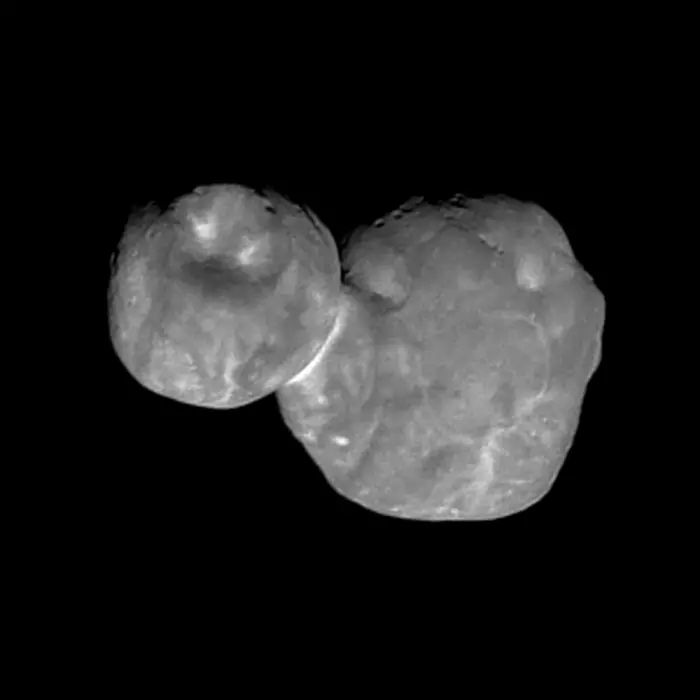
 Planetary scientists have long been puzzled by the snowman‑like shapes of many icy
bodies in the Kuiper Belt where roughly 10–25% of planetesimals consist of two spherical
lobes joined together. The NASA New Horizons spacecraft flew by Kuiper Belt object
Arrokoth (pictured right), which is a prototypical primordial contact binary.
Planetary scientists have long been puzzled by the snowman‑like shapes of many icy
bodies in the Kuiper Belt where roughly 10–25% of planetesimals consist of two spherical
lobes joined together. The NASA New Horizons spacecraft flew by Kuiper Belt object
Arrokoth (pictured right), which is a prototypical primordial contact binary.The Breakthrough Research
EES planetary scientists, graduate student Jackson Barnes and Prof. Seth Jacobson, working with Dr. Steve Schwartz, have recently published a paper that demonstrates how these unique "contact binaries"
are formed. Their study, which has been featured in a press release from the publisher The Royal Astronomical Society and major science news publications like Scientific American and The Guardian, uses numerical simulations to show that these shapes result from the gravitational collapse that first produced
planetesimals in our solar system. The computer models reveal a process where rotating clouds of pebbles break into two separate planetesimals. These bodies then orbit each other, gradually spiraling inward until they gently fuse while maintaining their round, spherical shapes. This pioneering work incorporates the necessary physics to reproduce these binaries,
providing critical insights into the early stages of planet formation.
International Recognition
The scientific community has responded with significant praise for the findings:
• “It is marvelous work,” says William McKinnon, a planetary scientist at Washington University in St. Louis who was not involved with the new work. “What the authors have done is demonstrate that the most direct pathway is indeed quite physically plausible”.
• Alan Stern, a planetary scientist at the Southwest Research Institute and principal investigator
of Nasa’s New Horizons mission to the Kuiper belt, welcomed the study. “It’s in agreement with previous work and support[s] the hypothesis that Kuiper belt
object Arrokoth, which New Horizons explored in a close flyby, is the result of gentle
formation processes,” he said.
Explore Further
For more details, including movies of the simulations and the full peer-reviewed article, please see the Publisher's press release and
news coverage linked below: